
How to Get Court Records
Begin with the Hawaii State Judiciary eCourt Kōkua access page, the fastest route to a public Hawaii County court record. Search the statewide JIMS data, narrow it to the Third Circuit, and jot down the exact Case ID along with the date and title of the docket entry you want. Reading the docket costs nothing. A PDF icon signals that a public image is for sale. It is not free or certified.
Each channel has its own job. A courthouse kiosk allows free on-screen review. Legal Documents staff handle inspection, ordinary copies, certified copies, and files that never made it online. Form 3 covers pickup, mail, fax, or email delivery. Call the right office before you mail anything or drive over for an old file. Phone staff can confirm who keeps the record and sketch the steps. Phone staff alone may not fill the whole order, though.
- Find the case and record its Case ID.
- Identify the docket date, title, and document.
- Buy an available ordinary PDF if suitable.
- Use a Hilo or Kona kiosk for free viewing.
- Contact the clerk for counter, mail, or certified copies.
- Submit Form 3 for inspection or a full or partial file.
Hawaii County Docket, Image, or Certification
Three distinct products get mixed up constantly. The docket is just the chronological index. It lists the filings and actions in a case. A filed image is the actual pleading, order, judgment, exhibit, or notice behind a given entry. A certified copy is a reproduction the clerk authenticates. A Hawaii County court record search can hand you the docket while leaving most images out of reach, and a plain PDF from the Judiciary system never counts as certified on its own.
| Product | What it provides | Best channel |
|---|---|---|
| Docket | Events, status, hearings, and image indicators | eCourt Kōkua |
| Filed image | Content behind a public entry | PDF purchase or kiosk |
| Certified copy | Clerk-authenticated copy under seal | Legal Documents |
Need only the filing history? The docket alone will do. Reading an order means pulling its image, while authenticated proof takes a direct certification request.
Types of Court Records
Court records in Hawaii County are sorted by court. Which court heard the case decides where the file lives. The Circuit Court of the Third Circuit keeps felony and major civil files. Probate and guardianship files sit there too. So do Circuit Family Court files. District Court clerks hold misdemeanors and violations. Traffic, parking, small claims, summary possession, and other District matters sit there too. Family Court keeps its own files, with tight limits around juvenile and protected cases. Appellate files sit with the Intermediate Court of Appeals or Hawaii Supreme Court clerks.
A public file might include complaints, petitions, answers, motions, notices, orders, judgments, satisfaction entries, hearing notices, and appeal filings. Exhibits can carry their own custody or format limits. Transcripts are a separate product ordered from court reporters rather than the copy counter. Hilo court reporters take requests at 808-961-7563; Kona uses 808-322-8785.
- Circuit criminal and major civil files
- District civil, traffic, and misdemeanor files
- Public portions of Family Court files
- Probate and guardianship records
- Public appellate files
Third Circuit Form 3 Requests
The searchable Hawaii Court Records Rules govern how Judiciary case records are handled. Form 3 is the standard request. It covers inspecting or copying a court or ADLRO record. For Hawaii County court records, choose the Third Circuit. Then choose the correct custodian, whether Circuit, District, Family, appellate, or Supreme Court. A precise request is easier for staff to retrieve and price.
| Requester | Name and enough contact information for a response |
|---|---|
| Case | Party names, Case ID if known, and case type |
| Custodian | Third Circuit plus the court or agency |
| Service | Inspection, complete copy, or partial documents |
| Delivery | Pickup, mail, fax, or email as available |
Want only part of a file? List the docket date and document title. State plainly that you want certification. Form 3 cannot lift a seal or override a confidentiality rule. A requester outside an authorized class needs the required court order first.
Routing matters on Form 3 in Hawaii County. Mark the Third Circuit, then say whether Circuit, District, Family, or an appellate office keeps the record. A felony order never lands beside a traffic disposition. Both cases arose on Hawaii Island, but the counters differ. The form also separates inspection from a complete copy and from selected documents. Give the entry date and title for a selected-document request so staff can find the right image without running a broad name search. Pickup, mail, fax, and email are the listed delivery choices, but the clerk sets the current instructions, payment steps, and estimate.
What a Court Record Contains
A Hawaii County case file often runs far deeper than its short header suggests. The docket ties together parties, hearings, filings, outcomes, and financial entries. Each entry proves one thing: JIMS recorded an event. It does not reproduce the paper that was filed. When exact wording matters, read the image itself.
| Header | Case ID, court, type, caption, filing date, status |
|---|---|
| Parties | Public names, roles, Party IDs, attorneys |
| Docket | Date, code, description, action, PDF icon |
| Hearings | Date, time, location, courtroom, judge, type |
| Outcome | Disposition, judgment, sentence, closure, appeal |
| Financial | Assessments, receipts, transactions, balance |
A closed status never substitutes for the final order. A motion entry records a request, not proof it was granted. Read the later orders and dispositions in sequence to see what the court actually decided.
Hawaii County Courthouse Kiosk Access
The Judiciary's public terminal and file inventory spells out free on-screen access to case files. Check it before planning any in-person Hawaii County court records search.
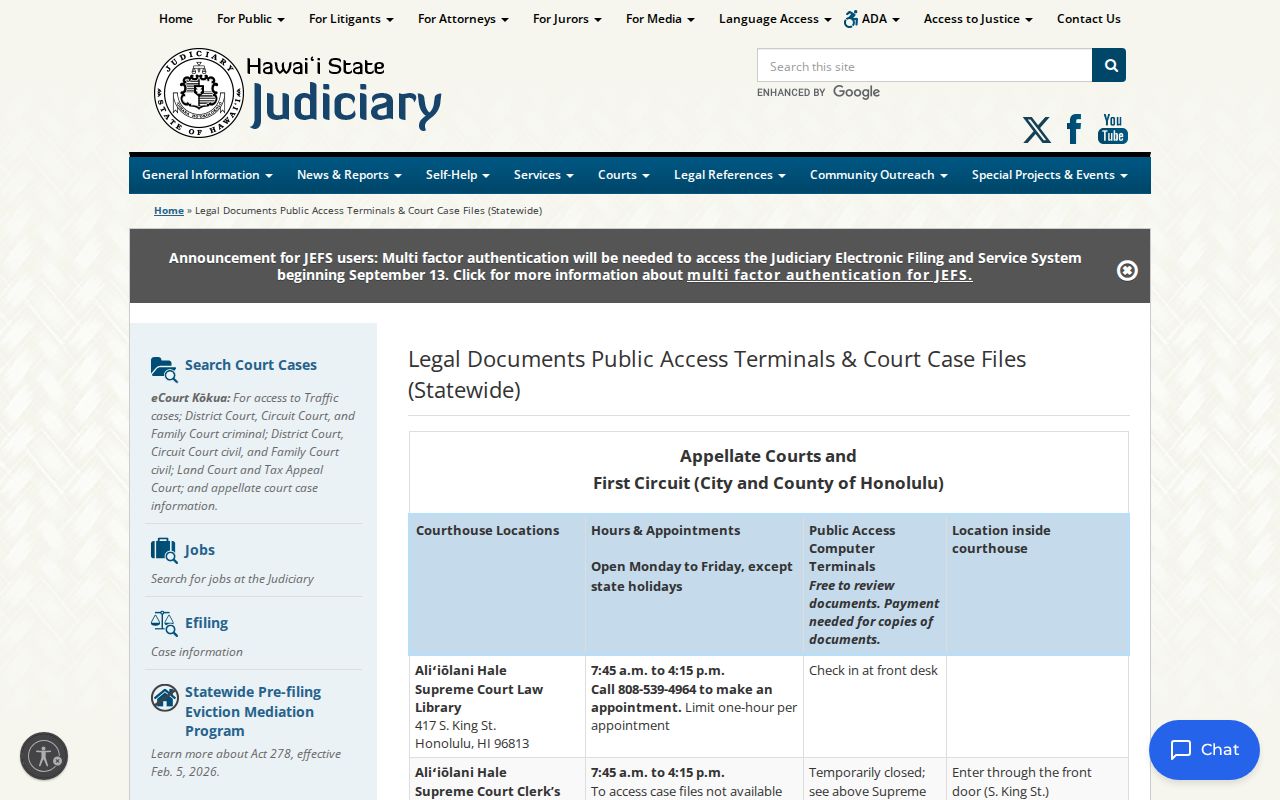
Some documents can only be viewed in person. A courthouse kiosk in Hawaii County may display public images that cannot be bought remotely. Printing still costs money. So do mailing and certification. At Hale Kaulike, look for computers by Legal Documents and in the Law Library. Keahuolū offers kiosk access too. Its posted access window is narrower than the building's general hours.
Older files call for a different plan. When a case is more than five years old, call ahead before traveling. The paper or bound file may sit in off-site storage. The docket can still appear online even while the document image waits on retrieval. Have the Case ID, court, entry date, and document name ready when you call. No uniform Third Circuit turnaround exists. Trust the clerk's case-specific retrieval estimate over any assumption of same-day counter access.
Older file check: Call before crossing the island for a file more than five years old because it may be stored off site.
Certified Copies and Fees
Don't treat every Hawaii County copy order as the same purchase. The hard-copy fee schedule and the Form 3 schedule are different animals. Mixing them leads to wrong expectations at the counter. Before you pay, ask the Legal Documents Section for a written estimate that matches your delivery channel. Keep in mind that online payments are nonrefundable.
| Record service | Amount or condition |
|---|---|
| Kiosk viewing | No charge on screen |
| Hard copy, 1 to 30 pages | $3 flat |
| Hard copy over 30 pages | $3 plus $0.10 per added page |
| Form 3 paper copy | $1 first page, then $0.50 each added page |
| Single eCourt download | Greater of $3 or $0.10 per page |
| Certification under seal | $2 per document plus copying |
| Mailing | Actual cost may be added |
There is no single price list for Hawaii County court records. A clerk search may carry an authorized fee. That applies when you show up with no case number. Bulk data is another lane entirely. It falls under HCRR Rule 10.13. It belongs with the Administrative Director, not a local counter clerk.
The two official fee schedules need to stay separate in your head. Current eCourt guidance sets a flat hard-copy charge for a document up through thirty pages. An added per-page amount applies beyond that point. Form 3 and the Court Records Rules instead publish a first-page and additional-page schedule. Which one applies depends on the source rule and how you want the copy delivered. Certification under seal is an added service, and mailing can add actual cost. A written estimate helps here. It keeps an ordinary PDF, a counter print, and a certified copy from being priced as one product.
Hilo and Kona Records Custodians
Hawaii County has no elected court-records clerk. The Legal Documents Section of the Third Circuit holds the main Circuit files. District and Family clerks each keep their own case records. Check the official Third Circuit directory before you visit.
Hale Kaulike Legal Documents
777 Kīlauea Avenue
Hilo, HI 96720-4212
808-961-7400
East Hawaii Circuit files and public computers.
Keahuolū Legal Documents
74-5451 Kamakaʻeha Avenue
Kailua-Kona, HI 96740
808-322-8750
West Hawaii Circuit files and kiosk access.
For District files, call the right courthouse. Pick by case type: Hilo at 808-961-7515, Kona at 808-322-8700 or 808-322-8703, and South Kohala at 808-443-2030. Pick the number by court and case type, not by where a party lives.
Legal Documents is not the transcript custodian either. A docket entry or minute record proves a hearing happened. But it is not a word-for-word account of what was said. Transcripts go through the court reporters instead: 808-961-7563 in Hilo, 808-322-8785 in Kona. Give the reporter the Case ID, the hearing date, and the court. Your request will not get confused with a clerk copy order.
Public Hawaii County Court Records
Hawaii County court records follow HCRR Rule 10.1. It opens court and ADLRO records to the public during business hours. A statute, rule, or court order can say otherwise. Closed and archived records are held to a reasonable turnaround too, provided they have not been destroyed, deleted, or transferred. Rule 10.2 then takes access further. It allows electronic reports, images, files, links, and internet delivery. The system itself must stay secure. Remote access is one option among several, in other words, and not a guarantee that every public field or document image reaches the web.
The HCRR publication is the official text, and its rules lay all of this out.
Getting a court record here runs through the Judiciary process. Hawaii County's general executive public-record queue plays no part. The HCRR rules control both your inspection rights and the limits on access.
Public Access and Sealed Records
A seal can attach to one document, one event, or an entire case. Even so, a restricted item may still show up on a Hawaii County docket. The listing itself must give away nothing protected. That docket entry marks a boundary on access; it does not mean the file vanished. Juvenile matters, protected Family Court cases, personal identifiers, and material under a court order may be unavailable remotely. Or they may be shut off completely.
Key Hawaii rules: HCRR Rules 10.1 and 10.2 govern ordinary inspection and electronic access. Rule 10.4 addresses authorized access to restricted records, while Rule 9 governs personal information.
No terminal gets around a seal. Form 3 grants no new right to restricted content. For ordinary Hawaii County court files, the Hawaii County case search is the practical first move, since it helps you pin down the Case ID.
Note: Confirm access and fees with the clerk, because rules, availability, and office procedures can change.