
How to Search Criminal Dockets
eCourt Kōkua is where a Hawaii County criminal docket search begins. It is the public face of the Hawaiʻi Judiciary Information Management System and covers public Third Circuit District, Circuit, and Family criminal cases. A Case ID is the best search key. Without one, Person Search works from first and last name, and you can narrow by filing date, case type, partial spelling, or phonetic spelling. A shared name proves nothing. Before relying on any docket, confirm the circuit, case type, filing date, caption, and Party ID.
The online search is only channel one. Hawaii County criminal docket entries can link to public document images, but the icon and the docket text are different things. If no image appears, use a courthouse kiosk for free on-screen inspection, call the right Legal Documents counter, go there in person, or send a written request on HCRR Form 3. Transcripts go to Court reporters, not Legal Documents.
- Open eCourt Kōkua through the Judiciary page and complete its disclaimer and CAPTCHA.
- Enter the exact criminal Case ID, or use Person Search with first and last name.
- Open the matching Party ID and verify that the case is in Hawaii County's Third Circuit.
- Read the header, charges, dated events, hearings, disposition, sentence, and latest status.
- Use the kiosk, clerk counter, phone, or Form 3 when a needed public image is not online.
Hawaii County Criminal Case IDs
The first digit in a Hawaii County criminal docket Case ID carries weight. A modern Circuit criminal identifier looks like 3CPC-YY-0000001. The 3 marks the Third Circuit. The type, year, and sequence pin down the file. Keep that first digit. Leading zeroes in the final sequence can sometimes drop out of a search. Yet the full identifier remains the safest reference for a call or written request.
Older criminal records may carry a migrated number. The Judiciary cites 3PC-15-1-123 as an old form that converts to 3PC151000123. Enter the conversion without hyphens, padded as shown. Very old files may not follow any intuitive pattern. So rely on the official conversion table rather than guesswork. A felony can also open in District Court. It may later run under a new Circuit Court Case ID. When a docket shows a transfer or later charging, run both tracks.
What a Criminal Docket Shows
A Hawaii County criminal docket opens with the court, Case ID, type, filing date, caption, and status. Party roles and counsel come next, along with each charge or count. Then events run in date order. Hearing fields list time, courtroom, location, judge, and setting type. Bond, warrant, financial, sentence, and appeal fields may show up too. Read every later entry. A first charge, an old setting, or a motion may since have changed.
| Case header | Third Circuit court, Case ID, case type, filing date, caption, and current status. |
|---|---|
| Charges | Count, offense, statute or class where entered, plea, and charge-level outcome. |
| Register | Filing or action date, event code, description, and PDF icon when an image is offered. |
| Hearings | Date, time, court location, courtroom, presiding judge, and hearing type. |
| Outcome | Plea or verdict, dismissal or acquittal, judgment, sentence, closure, and appeal. |
| Alerts and money | Bond events, active bench-warrant alerts, public fines, fees, restitution, and balance data. |
The Judiciary's docket and status definitions draw one line worth memorizing. Status tells you a case's present stage. It never replaces the plea, disposition, and judgment entries for each count.
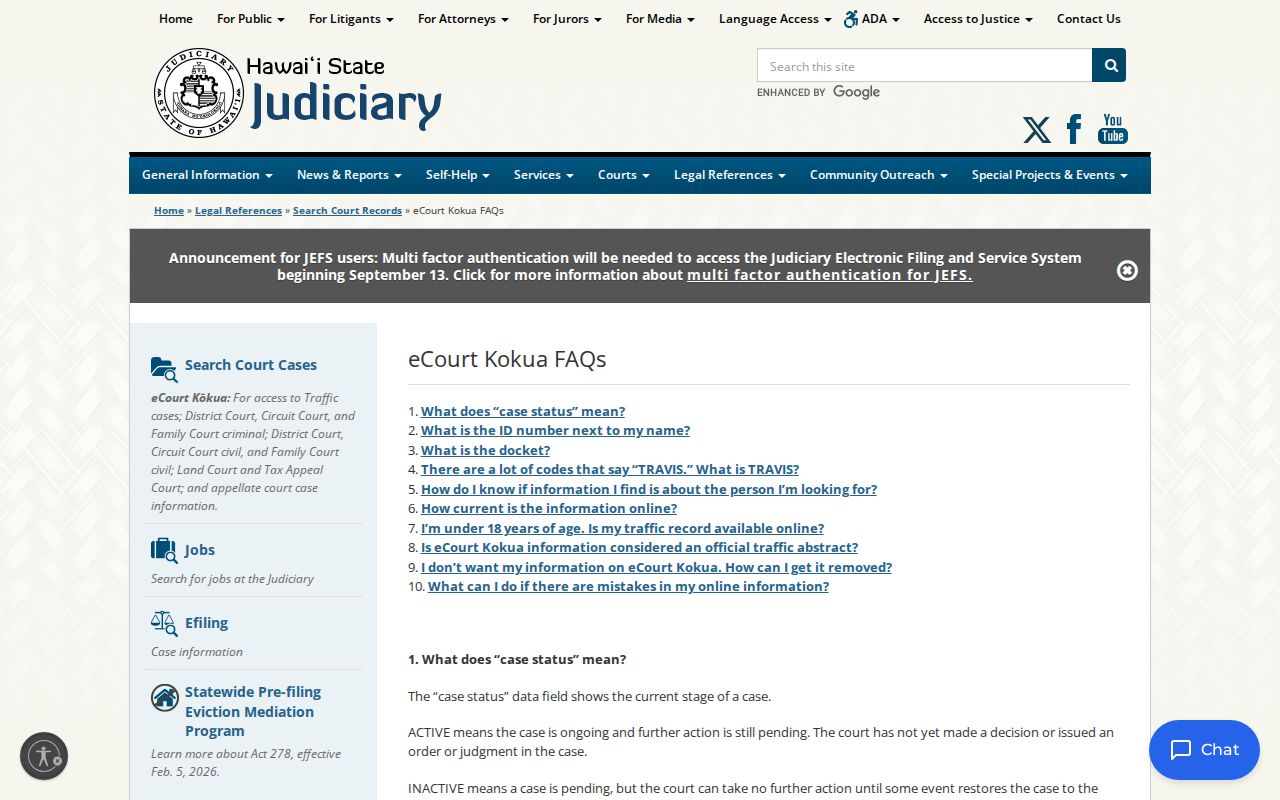
That official page reinforces the point: read the case header and the event history together, always.
Decode Hawaii County Guilty Entries
Short codes pack a lot into a Hawaii County criminal docket. Check them against the Judiciary's current code list. Three guilty entries are not interchangeable. GLP means a guilty plea accepted before trial. GLTB records guilt found by a judge after a bench trial. GLTJ records a guilty jury verdict. A judgment of conviction may show later as JOC.
- MDSM
- A motion to dismiss. It is a request, not proof that the charge was dismissed.
- MCON
- A motion to continue. Look for the court's order and any new hearing date.
- HMT and HH
- A hearing on a motion, and an entry stating that a hearing was held.
- GLP, GLTB, GLTJ
- A guilty plea, guilty bench verdict, and guilty jury verdict, each reached by a different path.
- JOC
- A judgment of conviction recorded after the court determines the criminal outcome.
The official eCourt Kōkua code list supplies event, motion, disposition, and financial codes.
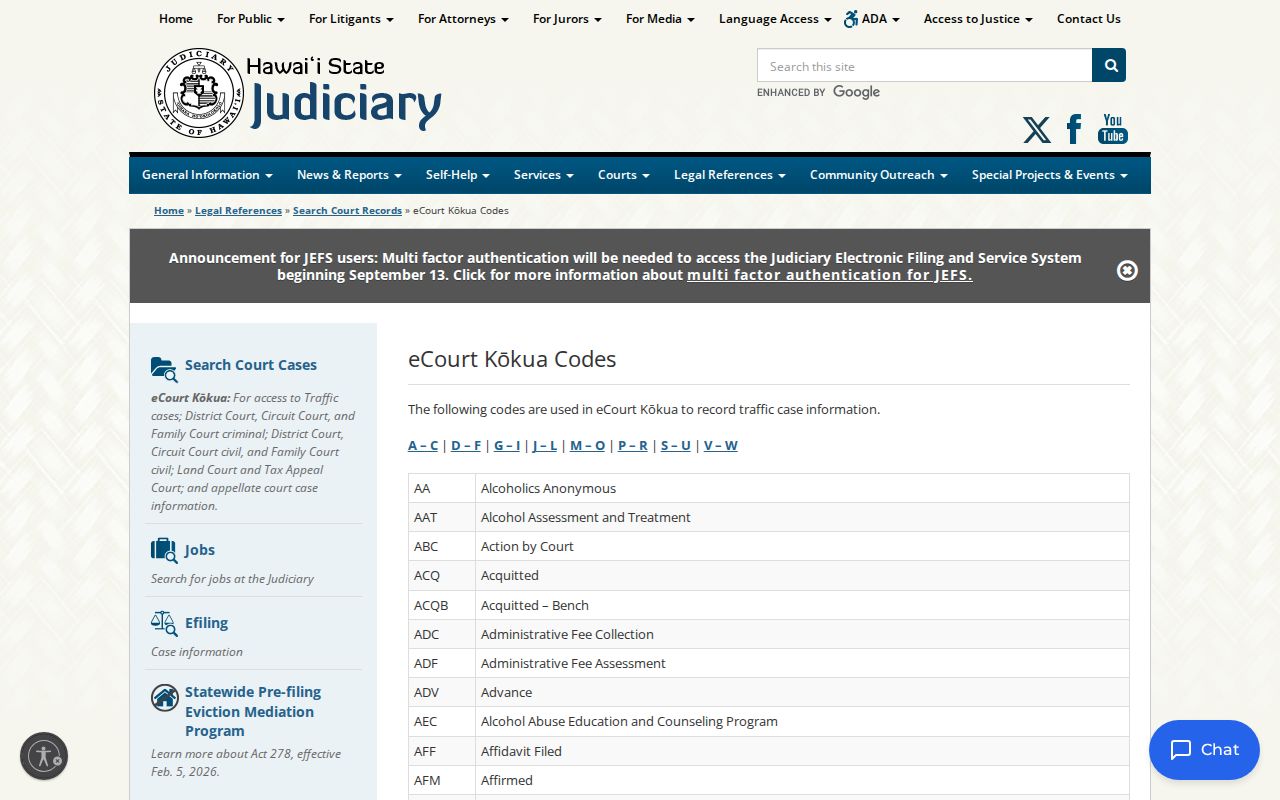
The code list helps you tell a filed request from an order, verdict, sentence, or final disposition.
Stages on a Criminal Docket
A Hawaii County criminal docket often opens with a complaint or early District Court proceeding. A felony then moves to Circuit Court through an information or indictment. Arraignment brings a plea. Pretrial history can hold motions, discovery filings, hearing minutes, continuance requests, and orders. Trial or plea entries give way to a disposition. Sentencing may record a judgment, jail, probation, public financial assessments, and later changes. An appeal gets its own Intermediate Court of Appeals identifier.
Docket flow: Filing → Arraignment → Pretrial → Plea or Trial → Disposition → Sentencing.
Treat that flow as a reading aid, not a promise every case takes each step. Dismissal, transfer, remand, and post-judgment filings can all bend the sequence. Charges inside one Hawaii County criminal case can end differently too. Read count-level dispositions and the latest order. Do not take the caption, or the word "closed," as the whole result.
Confirm Hawaii County Criminal Hearings
When a Hawaii County criminal hearing moves, the old setting stays in the event history. Check the current date in the scheduled-hearings area. Upcoming Court Hearings returns a real-time two-week view for nonconfidential cases. Search by Case ID for one case, or by court and location for a courtroom. If an old notice clashes with a newer order, call the courtroom or clerk. Seeing MCON does not mean the motion to continue was granted.
Current setting check: Compare the latest order, scheduled-hearings panel, and two-week hearing result. A saved screen may be stale after JIMS changes.
Phone beats guesswork for a hearing time. Hilo Circuit questions go to Legal Documents at 808-961-7400. West Hawaii Circuit callers use Kona Legal Documents at 808-322-8750. District criminal dockets split three ways. Hilo sits at 808-961-7515, Kona at 808-322-8700 or 808-322-8703, and South Kohala at 808-443-2030. If phones fail, the courthouse calendar posted each day is the same-day fallback.
Which Court Holds Criminal Dockets
Felony prosecutions in Hawaii County belong to the Circuit Court of the Third Circuit. Most misdemeanors, violations, and the early felony stages sit with the District Court of the Third Circuit. Family Court handles its own criminal and juvenile matters. Confidentiality rules keep much of that docket from public view, though. There are no municipal courts here. A case from Hilo, Kona, or Waimea still lives inside one unified state Judiciary.
That structure can spawn more than one Case ID for a single prosecution. A District Court complaint never merges into the Circuit Court file. Look for the transfer or charging entry. Then search the later filing number for the full criminal docket. For images and copies, East Hawaii uses the Legal Documents Section at Hale Kaulike. West Hawaii uses the counter at Keahuolū. Old files may sit in storage. A quick call before you drive over saves time.
Hawaii County Treatment Court Events
Treatment court in Hawaii County is not a peek into anyone's therapy. Proceedings stay tied to an underlying criminal Case ID. Only authorized hearings, probation events, and status entries show up on the public docket. The program lineup includes Hilo and Kona Adult Drug Court, Veterans Treatment Court, and Kona's Nā Hulu Wehi pilot. A docket records court events. It is not a clinical file.
For background on this distinct Third Circuit track, see the Judiciary's story of Big Island Drug Court. It offers local history.
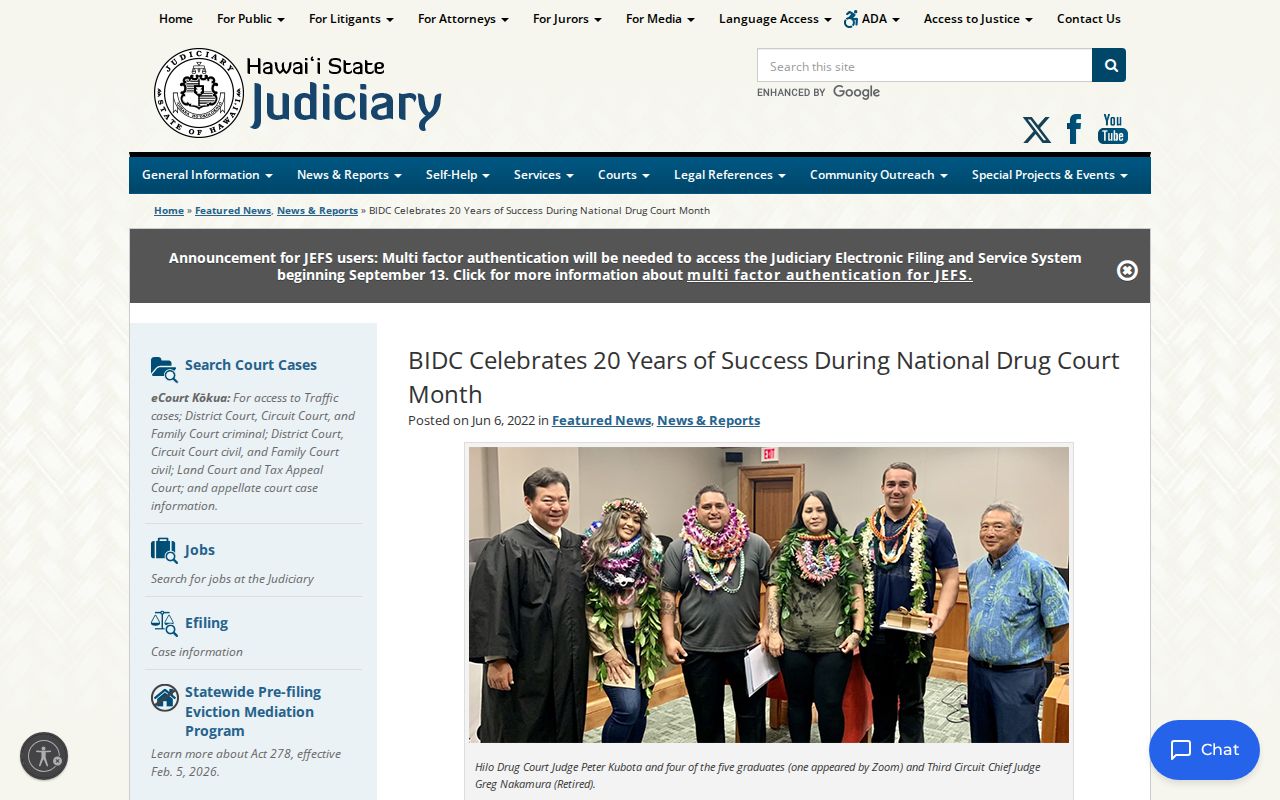
That history explains the pattern you will see. Status and review hearings recur under the existing criminal case, since no separate public treatment record exists.
Missing Hawaii County Criminal Images
A docket entry can be public while its image stays offline. A missing PDF icon may mean the filing predates remote coverage. It may have been never released through that channel, or it is restricted. And a PDF icon does not mean free. Eligible electronic images can be viewed at no charge on a courthouse kiosk. The clerk can quote ordinary or certified copy fees.
When you request a known public item, give Legal Documents the Case ID, party names, document title, and docket date. A written HCRR Form 3 request can seek inspection or copies by pickup, mail, fax, or email where offered. Hilo and Kona staff handle retrieval and cost estimates. Transcripts follow a separate court-reporter process; docket minutes cannot substitute.
Public Access and Sealed Criminal Dockets
Access to Hawaii County criminal records runs mainly through the Hawaiʻi Court Records Rules. Rule 10.1 opens court records during regular hours. A law, rule, or order can still restrict them. Rule 10.2 allows electronic access methods that protect system integrity. Rule 9 puts the burden on filers to guard personal information. None of this promises every case is searchable online.
Access boundary: Juvenile matters, protected Family Court cases, sealed filings, and restricted personal data stay unavailable to the general public. A clerk cannot waive a seal.
A sealed item can still appear by name in a Hawaii County criminal docket. The listing marks an access limit, not a lost file. Anyone outside an authorized class may need a judicial order to see more. Form 3 alone grants no right to restricted content. For open material, the working chain is eCourt Kōkua and free kiosk viewing at the courthouse. The clerk counter or phone comes next, and a precise written request finishes the job.